

Central Park Fall Foliage: Peak Dates, Best Photo Spots & When to Book Your Shoot
For about fifteen days every October/November, Central Park stops being a park and becomes a cathedral. The elms on the Mall close their golden ceiling over the path, the Lake doubles every red maple like it's showing off, and people who walk this park every single day stop mid-stride to take a photo.
I spend these days sprinting between shoots, and I spend the other 350 days explaining when they'll happen. There are some essential things to know about Central Park fall foliage: it peaks later than you think (most people assume "October" but it's 31 days!), it moves through the park corner by corner, and if you book your shoot for when the calendar says it's fall, you'll be standing under green trees in your nice outfits. This is the full guide I wish I could send every person visiting or exploring NYC and looking for a fall photoshoot: peak dates, twelve spots ranked by when they turn, three ready-made photo routes, what to wear, and the crowd traps to plan around.

When does Central Park fall foliage peak?
The short version: Central Park fall colors usually peak in early-to-mid November. Later than upstate, later than New England, later than the "peak foliage" maps on the news would have you believe.
The city runs warm. All that concrete holds heat, which delays the turn. Even the Central Park Conservancy notes the park "frequently experiences a later foliage turn than other parts of New York," and they run an arborist-approved foliage tracker each fall that's genuinely worth subscribing to. While upstate New York peaks in early-to-mid October, Manhattan is just warming up its oranges.

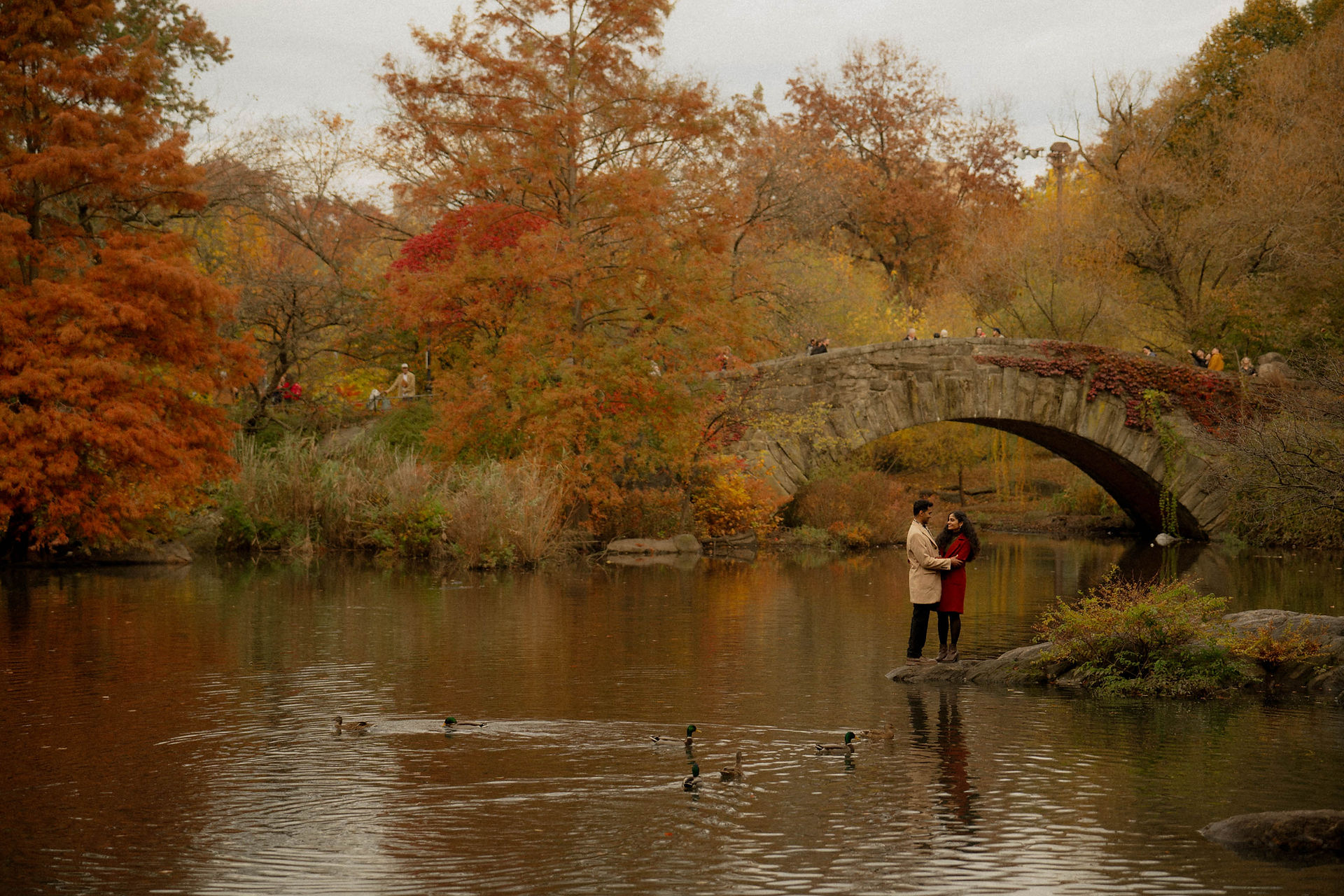
A rough Central Park foliage calendar:
Late September – early October: still mostly green, first hints in the North Woods. Don't book "peak foliage" shoots yet.
Mid-to-late October: the turn begins. Yellows arrive, the park looks warm rather than fiery. Softer light, thinner crowds, and the north end is already delivering real color.
Early November: the good week begins. Oranges and reds join in, the Lake starts mirroring color.
Mid-November: classic peak. The Mall goes fully golden. This is the postcard.
Late November: past peak but criminally underrated. A golden leaf carpet on the ground, bare-branch drama, moody light, and the park nearly to yourself.
Every year shifts by a week or so with the weather. A warm fall pushes the Central Park foliage peak later; an early cold snap pulls it in. Some years are simply better than others, and it's worth saying out loud. A dry summer can leave the display patchy and muted, with some trees browning and dropping early while their neighbors go out in flames. A wet, mild autumn can produce a slow-motion peak that lasts three weeks. I can't control which year you get, but I can promise you this: even in a "bad" foliage year, the Mall still goes gold, the leaf carpet still happens, and the photos still look like fall. We just get pickier about which trees we keep in our background!


The best Central Park fall foliage spots (and when each one turns)
Not every corner of the park turns at once, which is great news: it stretches "peak" into nearly a month if you know where to walk. All of these live in my Central Park photoshoot locations guide; here's the fall-specific timing, roughly south to north.
Gapstow Bridge & the Pond — skyline plus color
Turns: late October onward. Foreground foliage, still water, and midtown towers behind. This is the shot that says fall in New York rather than just fall. Best in the first hour after sunrise, before the tourist current picks up. The Hallett Nature Sanctuary above the Pond (limited open hours) is one of the Conservancy's own foliage picks, and its overlooks feel like a secret.
Sheep Meadow's edge & Cop Cot — the warm-up
Turns: early November. The tree line around Sheep Meadow glows in late light, and the rustic Cop Cot gazebo above it is an easy, quiet first stop that most people walk right past.
The Mall & Literary Walk — the main event
Turns: mid-November, late and fast. The cathedral of American elms is the Central Park fall photo. Elms go deep gold, the canopy closes over the path, the ground fills with yellow leaves, and you get maybe ten perfect days. It's also the most crowded spot in the park at exactly that time. Sunrise or accept humans in your backdrop; a longer lens and low angle can melt the crowd into bokeh, but empty-Mall photos are earned before 8am.
Bethesda Terrace — golden hour, literally
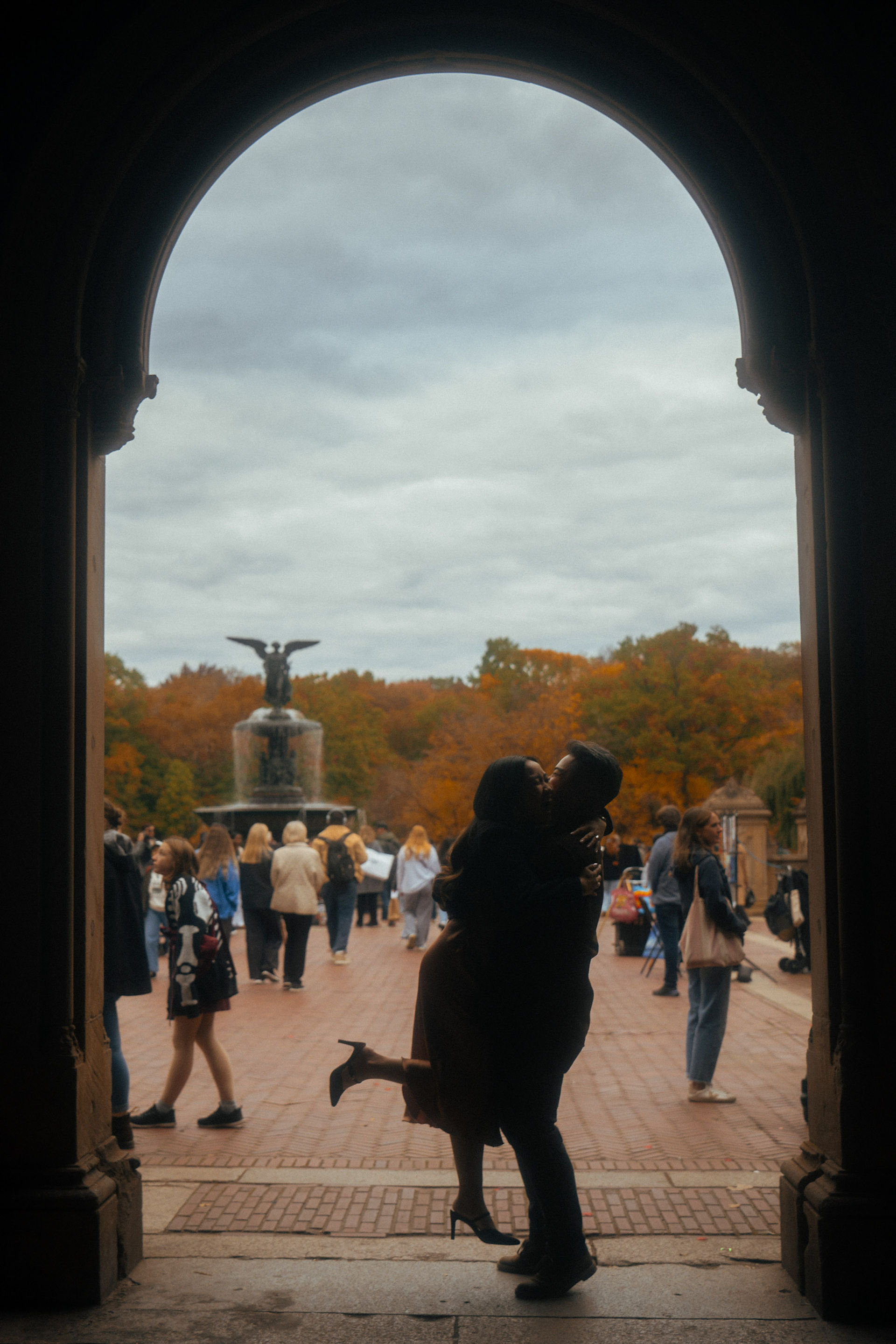
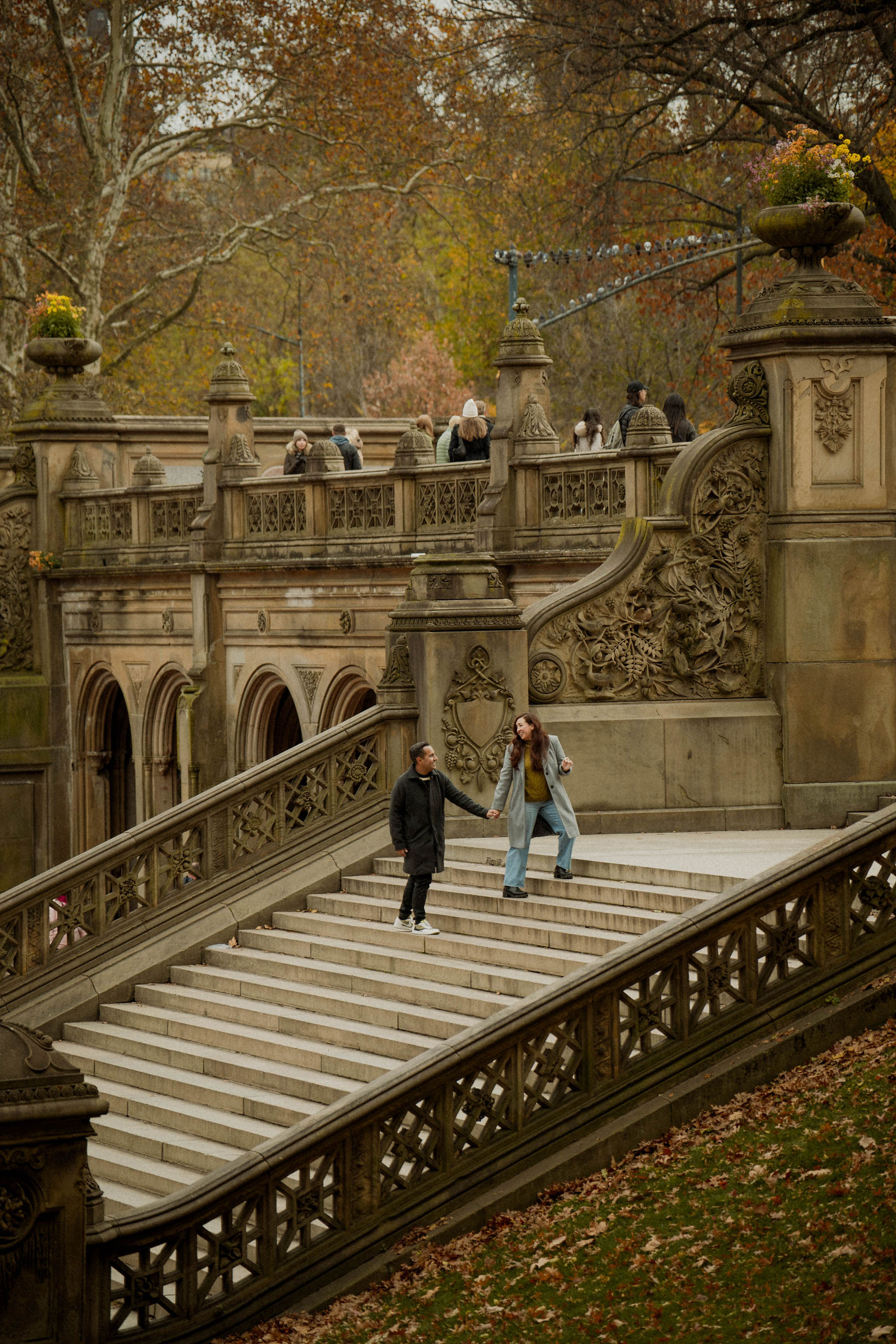
Turns: with the Mall. The terrace pairs those golden elms with warm sandstone, and the whole scene glows in late-day light. The arcade underneath is also your rain plan and your warm-up spot between locations. Full breakdown in my Bethesda Terrace guide: angles, permits, quiet hours, hidden corners.
Bow Bridge & the Lake — the reflection shot
Turns: late October into early November. Red and orange maples over the water, and on still mornings the reflection doubles the color. Arrive early; by 10am on a peak Saturday you're queueing for bridge space. Wagner Cove and the Ladies' Pavilion, both a short walk along the Lake, catch the same color with a fraction of the people.
Hernshead & Oak Bridge — the Lake without the line
Under ten minutes' walk from the Bow Bridge queue, almost nobody. Hernshead is the little rocky peninsula jutting into the Lake by the Ladies' Pavilion, all glacial rock and overhanging color at the waterline. Oak Bridge, at the entrance to the Ramble at Bank Rock Bay, gives you the same over-the-water framing as Bow Bridge with a fraction of the audience. When the bridge is a scrum, this is where we go, and honestly the light through the trees at Bank Rock Bay might be better anyway.
The rowboats — the moving backdrop
Best: late October–early November, weather permitting. When the Boathouse rowboats are still running, a couple in a boat surrounded by fall color is one of my favorite sessions of the year: the Lake does half the work and no crowd can follow you. Bring layers, expect wobbly getting-in photos, keep the ring in a zipped pocket. (Confirm rentals are still running the week of your shoot.)
The Ramble — the forest one
Turns: from late October. If you want new york fall pictures that look like you eloped to Vermont without leaving Manhattan, the Ramble's winding paths turn mixed gold and rust, and because it's woodland it feels private even at peak. This is where I take camera-shy couples in the fall: no audience, all atmosphere.
Belvedere Castle & Turtle Pond — the overlook
Turns: early-to-mid November. From the castle terraces you look across the canopy instead of up at it, with Turtle Pond mirroring the color below. Great wide establishing shots, and one of the few places the foliage reads at scale.
The Reservoir & Bridle Path — the runner's secret
Turns: early-to-mid November. The soft gravel Bridle Path under turning trees, with the skyline across the water, is a Conservancy foliage pick and a beautiful walking-shot location: hands in pockets, laughing, leaves drifting. The west side around 90th Street is a relaxed stretch. The full loop runs about a mile and a half if you want a proper golden-hour walk, and the stretch near the south gatehouse frames the San Remo towers over the water, the most New York backdrop in the whole park wearing its most un-New York colors.
Conservatory Garden — the formal one
Turns: early-to-mid November. Chrysanthemums in the beds, late-turning trees, and the quietest official quiet zone in the park. If your style is manicured rather than wild, this is your spot. Full guide here.
The Pool — first to turn, most underrated
Turns: late October, first in the park. The red maples around this small water body at 100th Street on the west side light up before everything else, reflected in still water, with almost nobody around. If your schedule forces an earlier shoot, this is where the color already lives.
The North Woods & the Ravine — the wild one
Turns: late October into November. Waterfalls, stone arches, and proper forest. The Glen Span and Huddlestone arches under fall canopy don't look like Manhattan at all. Combined with the Pool, the north end is a full session on its own, and it's the move for marathon weekend when the south end is chaos.


Three ready-made fall photo routes
The classic (60–90 min): enter at 72nd Street, the Mall → Bethesda Terrace → Wagner Cove → Bow Bridge. A half-mile of nonstop backdrops; the exact spine of my cinematic fall photoshoot in Central Park. Book it for the first two weeks of November, start at sunrise or two hours before sunset.
The relaxed north (60–90 min): enter at 100th–103rd on the west side, the Pool → the Ravine and arches → North Woods, finish at Conservatory Garden. Earliest color, fewest people, best for late October.
The overlook mix (90–120 min): Bow Bridge → the Ramble → Belvedere Castle and Turtle Pond → out along the Reservoir Bridle Path. Forest, castle, water, skyline: maximum variety in one walk.
Fall photoshoot ideas (beyond standing under a pretty tree)
A few ways I love to use the season, whether it's engagement photos, an anniversary, or a just-because session:
The leaf toss, done right. Yes, it's a cliché. It's also joyful every single time. The trick is doing it on the leaf carpet a few days after peak, throwing up and slightly behind you, and committing fully. Half-hearted leaf tosses photograph like regret.
The walking date. Coffee in hand, Bridle Path or Ramble, zero posing. My documentary-style favorite: you two just take a walk in the best-dressed park on earth and I orbit.
The picnic blanket. A wool blanket, a thermos, the low November sun. Sheep Meadow's tree line or the Great Hill. Cozy reads on camera better than almost anything.
The rowboat session. See above. Bring a thermos, wear the knit.
The blue-hour skyline finish. Because sunset is so early in November, you can shoot golden hour and city lights by 5:30pm. Gapstow with the glowing skyline behind you is a whole second look in the same session.
The holiday card + save-the-date play. This is the most practical reason to book early November: shoot at peak, and your gallery lands right in time to become holiday cards, and if you're engaged, save-the-dates for a spring or summer wedding. One session, three usages. The couples who figure this out book the first week of November and coast into December feeling smug, don't wait for a January shoot in coats for a save-the-date you needed yesterday.
The dog cameo. Fall is the best season for it: your dog, a pile of leaves, physics. Enough said.
Props that don't feel like props. My rule: if you'd carry it on a real fall date, it works. A thermos and two cups, a wool blanket, a scarf long enough to wrap around both of you, the bodega coffee. What doesn't work: anything you bought specifically to hold in a photo. The season is already the prop, you're standing inside the most photogenic set decoration.
Planning a fall proposal at peak color?
Early November is quietly one of the best proposal windows of the year: peak backdrop, cool-but-comfortable weather, and it leads straight into the holidays (ring in November, Christmas in New York engaged). The playbook lives in my Central Park proposal guide; for foliage specifically, Wagner Cove and the Ladies' Pavilion give you peak color with no crowd to perform for, and the leaf carpet makes even the kneel look art-directed. Plan the outfit like it matters, because it will be in every frame: here's what to wear to propose.




What to wear for fall photos in Central Park
The leaves are doing a lot of orange; your job is to harmonize, not compete.
Colors: deep warm neutrals photograph best against foliage — rust, cream, camel, chocolate, olive, forest green, ochre. Denim and grey work as supporting players. Skip bright red (it fights the leaves), skip neon, and be careful with orange-on-orange unless you want to cosplay as a maple.
Texture over print: chunky knits, wool coats, suede, corduroy. Fall light is soft and directional, and texture catches it beautifully. Busy prints steal attention from faces.
Movement: long skirts and dresses that move, coats worn open, scarves that can be thrown. November has breeze; use it.
Practicalities: real shoes for real walking (the routes above cover a mile-plus), layers you can shed for two minutes of the "cold look" and re-wrap between spots, and hand warmers in pockets. Cold couples photograph exactly as cold as they are.
Hair, wind, and the unglamorous kit. November has opinions about hairstyles. If you're wearing it down, bring a clip for between-spots and we'll use the wind instead of fighting it: moving hair photographs romantic, hair in your mouth does not. And pack the tiny essentials kit: tissues (cold eyes water), lip balm, hand warmers you can palm during close-ups. Cozy on the inside shows up on camera as chemistry.
More outfit thinking in what to wear for your NYC surprise proposal — the color logic is the same for any fall session.
Timing, crowds, and the traps nobody warns you about
Book the date for the first two weeks of November, then watch the trees. If I could make every couple planning fall engagement photos do one thing, it's this. Mid-October dates feel autumnal on the calendar and green in the photos.
Sunrise is the cheat code. Peak foliage season is peak tourist season. At 7am, Bow Bridge is yours. By 11am, it belongs to everyone.
Sunset is EARLY. Clocks fall back the first Sunday of November, and sunset drops to roughly 4:40pm mid-month. "Afternoon shoot" in November means starting around 3pm. Every year this ambushes someone; don't let it be you.
Backlight is why fall photos glow. Quick insider note on why the timing matters so much: leaves are translucent. Lit from behind by a low sun, they light up like stained glass; lit from directly above at noon, they go flat and dark. That low-sun glow is the entire look you're imagining when you picture fall photos, and in November it only exists in the first and last two hours of the day. As a NYC candid photographer, when I suggest sunrise or a 3pm start, this is what I'm thinking about!
Marathon weekend is real. The NYC Marathon runs the first Sunday of November and finishes inside the park, with closures and enormous crowds on the west side and south end for the whole weekend. Either embrace the energy, book a different day, or shoot the north end route.
Weekdays beat weekends by a mile. A Tuesday at peak beats a Saturday at peak, every time. If you can only do weekends, sunrise is non-negotiable for the Mall and Bow Bridge.
Overcast is a gift. Clouds turn the sky into a giant softbox and make the reds and oranges richer, not duller. Don't reschedule for grey; reschedule for sideways rain. Even then, rain has its own magic, and Bethesda's arcade is the best rain cover in the park.
The day after rain is a secret weapon. Wet bark goes almost black, which makes the color pop twice as hard; the paths hold mirror puddles, and the park is half as crowded because everyone canceled yesterday. If a storm rolls through mid-peak, don't mourn the shoot: move it to the next morning and thank the storm.
Wind is the deadline. One good November storm can take The Mall from peak to bare in 48 hours. When the color is there and the forecast shows wind and rain, shoot now, not Saturday.
Permits: a small session with handheld gear generally doesn't need one; details in my permit guide, and NYC Parks has the official rules for bigger productions.


FAQ about Central Park fall foliage photos
When is peak fall foliage in Central Park?
Typically early-to-mid November, a week or two later than the surrounding region. The city's warmth delays the turn, and the Conservancy's foliage tracker confirms timing each year.
Is late October too early for fall photos in Central Park?
Not if you pick the right spots: the Pool, the North Woods, the Ravine, and the Ramble turn first. The Mall's elms won't be golden yet.
Does the NYC Marathon affect fall photoshoots?
The first weekend of November brings closures and huge crowds to the west side and south end. Shoot the north end that weekend, or pick another day.
Do I need a permit for a fall photoshoot in Central Park?
For a small session with handheld gear, generally no. Full details in the permit guide.
What time should we shoot?
Sunrise for privacy, or golden hour starting around 3:00–3:30pm in November, since sunset lands around 4:40pm after the clocks change. Midday at peak season means crowds in every frame.
Where are the best fall photos in Central Park?
The Mall for the golden canopy, Bow Bridge for reflections, the Ramble for forest, Gapstow for skyline-plus-color, the Pool for the earliest reds. One hour only? Walk the Mall → Bethesda → Bow Bridge.
Are fall colors in Central Park the same dates every year?
No, they shift a week or so with the weather. A warm autumn delays peak; an early cold snap accelerates it. Watch the Conservancy tracker (or ask your photographer; watching trees is part of my job in October).
How long should a fall photoshoot in Central Park be?
For one location cluster like the Mall–Bethesda–Bow Bridge spine, 60–90 minutes is the sweet spot. Want two distinct looks (forest plus skyline, or golden hour into blue hour)? Plan on two hours. Shorter than 45 minutes at peak season mostly buys you walking, not photos.
What if it's a weak color year?
It happens, a dry summer can mute the show. The park is big enough that some corner always delivers, and part of what I help you with in October is knowing which one. Worst case, we lean into the leaf carpet, the low golden light, and the moody bare-branch look, which some couples end up loving more than the postcard version.
Want Your Photos at Peak Color? Let's Lock In Your Date
Fall dates are the first thing to go every year, and peak week doesn't reschedule itself around anyone's calendar. If you're dreaming of a fall couples session or a fall proposal under the golden elms, reach out early and we'll aim your date at the good week together.
Keep reading: my favorite NYC fall photo spots beyond the park (Fort Tryon's heather garden and cloisters views turn beautifully too), all my NYC engagement photo locations, and for the spring version of this obsession, the cherry blossom guide.


Comments