

Best Central Park Photoshoot Spots: The Complete Guide
Central Park is 843 acres. Most photographers use about twelve of them. Bow Bridge, Bethesda Terrace, the Mall: they're iconic for a reason, and they'll always earn their place on this list. But Central Park has more photogenic corners than most people discover in a lifetime, and some of the most extraordinary engagement photos and couple portraits come from places that don't appear on any tourist map.
This is the complete guide: the iconic spots, the quieter alternatives, and the ones that only reveal themselves when you know where to look.

A Few Things Worth Knowing Before You Go
Timing matters more than location
The best photographs in Central Park happen in the first hours after sunrise and the last ninety minutes before sunset: for engagement photos in Central Park, that early light is everything. Midday light is flat and the crowds are at their worst. If you have flexibility, early morning on a weekday is the closest thing to having the park to yourselves.
One thing worth knowing about sunset specifically: because the park is surrounded and sheltered by buildings and dense tree canopy, the golden hour light disappears earlier than the actual sunset time suggests. The sun drops behind the skyline before it ever hits the horizon. But don't pack up when it does: the twenty to thirty minutes after the light goes are some of the most beautiful in the park. The crowds thin, the sky holds a soft blue glow, and the whole place takes on a stillness that golden hour, at its busiest, rarely has. That twilight window is its own kind of magic and it photographs beautifully too.
Permits
Ceremonies with groups of 20 or more people require a permit through the Central Park Conservancy. For smaller groups (couples, families, small gatherings), you generally don't need one, though rules can change. Rules can and do change, so always verify directly before your date.
For casual photography with a handheld camera (which covers the vast majority of couples sessions and engagement shoots), you generally don't need a permit as long as you're using a handheld camera or a camera on a tripod, not asserting exclusive use of the space, and not bringing in production equipment beyond basic handheld items. A photographer, a couple, and a camera bag falls comfortably within this.
For ceremonies, special events permits are required whenever twenty or more people will be present. Under that threshold, a small ceremony with an officiant, witness, and photographer doesn't require one, though getting a permit even when it isn't strictly required is worth considering.
A permit gives you documented claim to a specific space for a specific time, and it's within your rights to politely ask others to clear the area you've reserved. That said, be realistic about what a permit does and doesn't do: the park won't enforce it on your behalf, there are no signs, no barriers, and no guarantee the spot will be empty when you arrive. It's a layer of legitimacy, not a guarantee of privacy. For a small elopement or ceremony, arriving early on a weekday morning will do more for your solitude than any permit will.
Weather makes the photographs
An overcast day gives you even, flattering light with no harsh shadows. Light rain empties the park of crowds and makes the atmosphere misty and lush. Don't reschedule for clouds. It's still a great day for an iconic Central Park photoshoot.
The Iconic Spots (and Why They Still Work)


Bethesda Terrace & Fountain
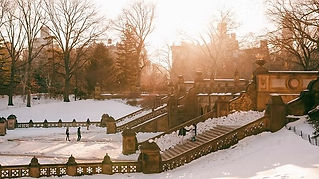
The architectural heart of Central Park — a two-tiered esplanade descending to the Lake, anchored by the Angel of the Waters fountain and framed by ornate stonework on all sides. The covered arcade beneath the terrace has Minton tile ceilings that were restored in the 1980s and are among the most beautiful interiors in New York.
Bethesda Terrace is one of the most-requested spots for Central Park engagement photos, and it photographs at every time of day and in every season. The tile ceiling of the arcade gives you a stunning indoor-feeling backdrop even outdoors. The fountain itself, the stone stairs, the views across the Lake toward Bow Bridge — there are more distinct photographs available here than in almost any other single location in the park.
Best timing: Early morning for the fountain and terrace (before crowds arrive around 9 AM); the arcade works any time of day since it has its own light.
Pro tip: Most people photograph the fountain from the south. Walk around to the north side of the terrace and look back toward the arcade — it's a completely different and often more dramatic frame.
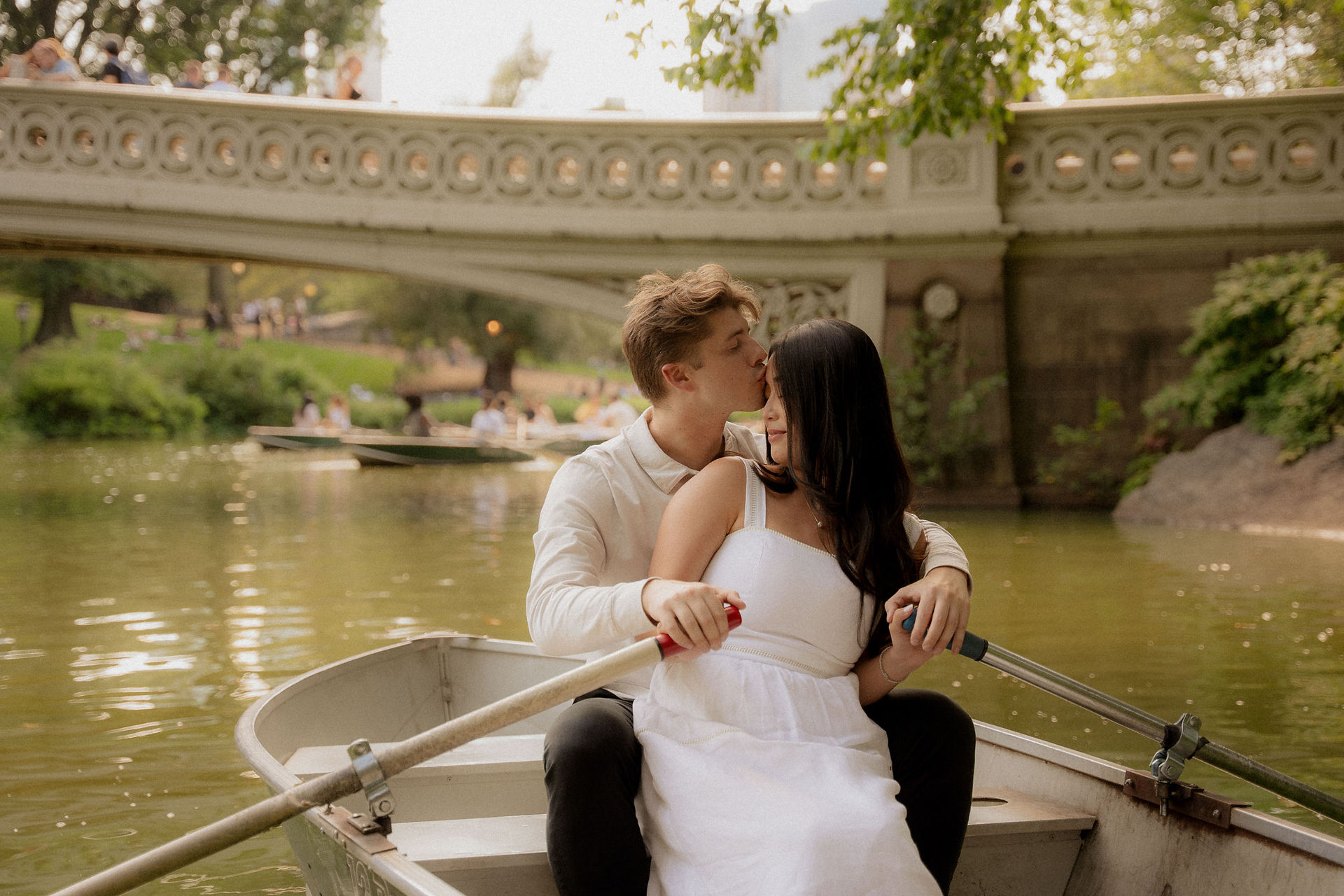
Bow Bridge
The most romantic bridge in New York. The cast-iron span curves gently over the Lake, with the city skyline visible above the treeline to the south and the Ramble's dense woodland to the north. In every season it's extraordinary: cherry blossoms in spring, full green in summer, fire in fall, bare branches and sometimes snow in winter. The view from the bridge is what most people photograph. The view of the bridge — from the shoreline to the east or west — is often even better and much less crowded too.
Best timing: Sunrise on a weekday. By 9am on weekends it's busy enough to require patience. Still doable with a professional engagement photographer who knows how to work around the crowd!
Less obvious angle: Walk to the eastern shoreline of the Lake, just north of the Loeb Boathouse. From here you get Bow Bridge in the background with the water in the foreground: a completely different photograph from the one everyone else takes.

Gapstow Bridge
The stone bridge at the southern end of the park, arching over the Pond near the 59th Street entrance. Gapstow is built of rough-cut stone and feels almost medieval, more rugged, more dramatic, and is a good option for couple photos in Central Park with fewer crowds. The view from the bridge toward the skyline through the trees is one of the most cinematic in the park. And because most people head straight for Bethesda Terrace, the Pond area stays a bit quieter.
The angles worth knowing:
From the bridge looking south: The Plaza Hotel, Essex House, and the towers of 59th Street rise directly behind the Pond, and on still mornings the reflections in the water are extraordinary. This is the classic shot: city through trees, water as a mirror.
From the rocky outcropping on the water's edge path: The small rocky outcropping along the Pond's edge path gives you the best view of the bridge itself: the full arch framed by foliage, with the skyline visible above. This is the photograph of the bridge, rather than from it. Worth the two-minute detour.
From the north side approaching the bridge: The bridge frames whoever stands beneath it against the sky: a cleaner, more graphic composition than the skyline view, and completely different in feeling.
Best timing: Sunrise for the skyline reflections and the quietest crowds. Fall is particularly extraordinary: the surrounding trees turn red, orange, and gold against the stone, and winter after snow is its own kind of magic. Midday in summer is the one time to avoid — the light is flat, and the area gets busy being so close to the 59th Street entrance.
The Mall and Literary Walk
A straight, tree-lined promenade running north-south through the center of the park, flanked by American elm trees that form a cathedral canopy overhead. In fall, the leaf color here is extraordinary — gold and amber light filtering through the branches onto the path below. In winter, bare branches create graphic, architectural patterns against the sky.
The statues along Literary Walk are less photographed than the tree canopy: worth exploring for couples who want something with more character than a standard tree-tunnel shot.



The Quieter Alternatives
The Ladies Pavilion
A Victorian cast-iron gazebo on the western shore of the Lake, overlooking the water toward Bow Bridge. Far less visited than Bethesda Terrace or Bow Bridge despite being just a short walk away — and arguably more intimate. The ornate ironwork, the lakeside setting, and the view across the water make it one of the most beautiful small structures in the park.
What most guides don't mention: just steps from the pavilion, a stretch of flat exposed rock reaches out over the Lake — one of the best natural platforms for portraits in the entire park. The combination of smooth stone underfoot, deep green water behind you, and the lush tree line across the shore creates a frame that feels both wild and painterly. Depending on where you position, you can also catch a glimpse of the midtown skyline peeking above the treeline to the south — worth scouting with your photographer on arrival to find the exact angle, as it's perfect for a Central Park photoshoot.
This is a favorite location for elopement ceremonies, vow exchanges, and engagement sessions in Central Park. Small, sheltered, surrounded by water on three sides, it creates a natural enclosure that feels private even in a public park.
Best timing: Early morning. By mid-morning it starts to see more foot traffic.
Wagner Cove
A small, sheltered cove on the western shore of the Lake, just south of the Ladies Pavilion. A wooden dock extends over the water, surrounded by willow trees that trail into the Lake. It's quiet, genuinely romantic, and almost completely unknown outside of photographers who specifically seek it out. For couples who want something that feels discovered rather than designated — this is it.
Cop Cot
A rustic wooden gazebo on a rocky outcropping near the 60th Street entrance, surrounded by trees and elevated above the surrounding paths, is one of the more underrated spots for NYC engagement photos. From inside the gazebo, you get a filtered, dappled light that's unlike anywhere else in the park. From outside, it photographs against the trees with a storybook quality. It's often overlooked in favor of the more architecturally elaborate Ladies Pavilion, which means it's frequently empty.
Pinebank Arch
Almost completely overlooked because it sits so close to the park's edge that most visitors walk straight past it toward the interior. Pinebank Arch is an elegant cast-iron bridge spanning the bridle path, designed to seem to emerge from the rock outcrops on either end, with lacy ironwork that almost blends into the surrounding foliage.
It's one of five of the original seven cast-iron bridges remaining in the park — historically significant and genuinely beautiful, with the delicate ironwork providing a completely different texture than the stone bridges elsewhere. For couples who are entering from the west side or Upper West Side, this is a natural first stop before heading deeper into the park.
The Hidden Ones
The Hill Between Cherry Hill and Bow Bridge
One of those spots that has no official name and no signage pointing to it, which is exactly why it works. Wildly underused for couple photography in Central Park, the gentle slope between Cherry Hill and Bow Bridge, just off the main path, gives you an elevated vantage point over the Lake with Bow Bridge in the mid-distance and the San Remo Building rising above the treeline beyond it. It's the shot most people are trying to get from the bridge itself, except that here the bridge becomes part of the composition rather than the thing you're standing on. Wildly underused.


The Pine Grove
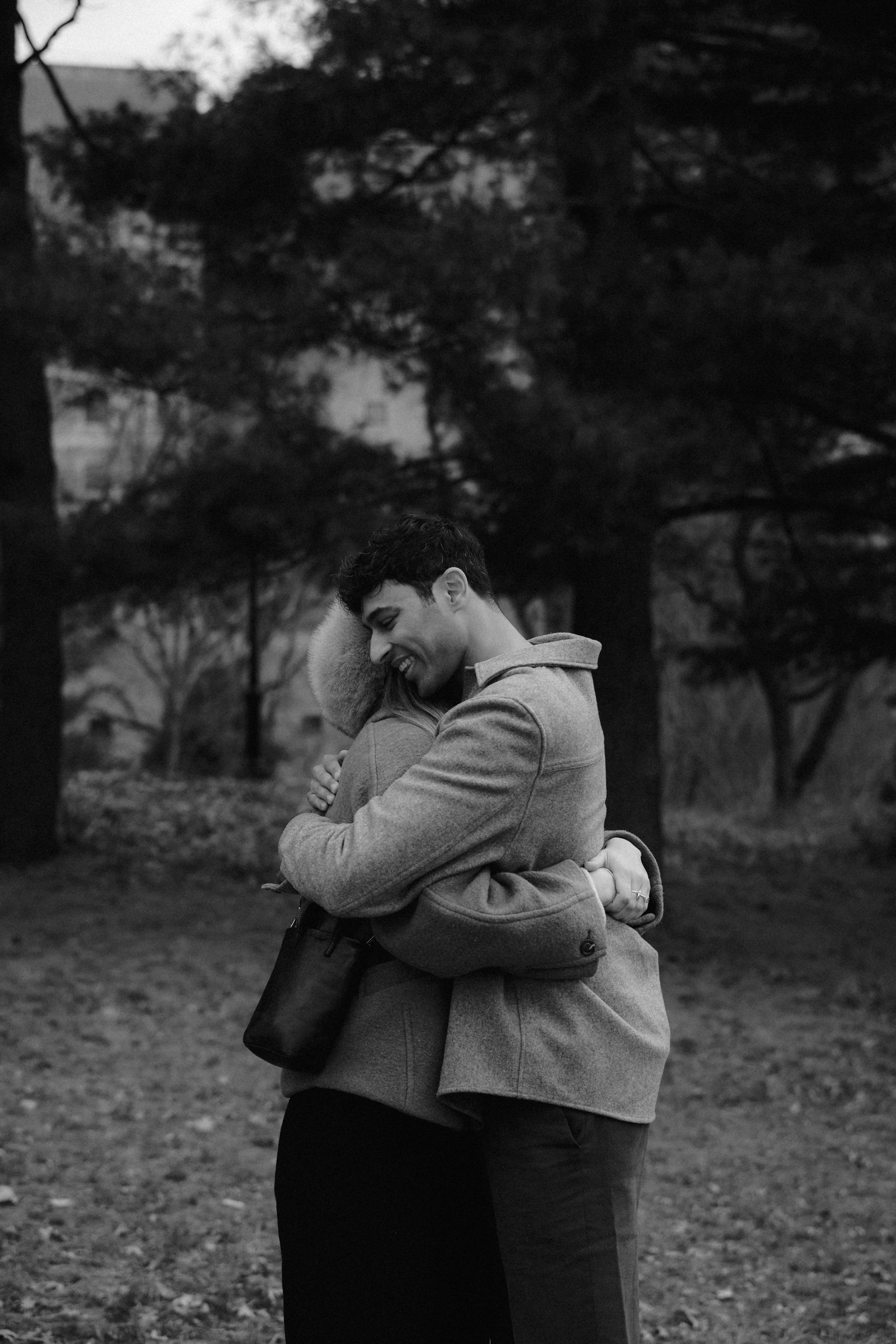
The northern end of the park shifts in character entirely around 97th–100th Street, and the cluster of pine trees in this area is one of the most atmospheric and least visited spots in the park. The dense canopy filters light differently than the deciduous trees that dominate the rest of the park: darker, more textured, with a quality that reads almost like a forest rather than a city park. In winter especially, when the rest of the park is bare, the pines stay full and green. Completely off most photographers' radar.
The Shakespeare Garden
Tucked into the west side of the park near 79th Street, this terraced garden is planted entirely with flowers and plants mentioned in Shakespeare's works, which sounds like a trivia fact and turns out to be a genuinely beautiful space. Stone paths, iron fencing, wild plantings, benches set into hillside terraces. In spring and early summer it's in full bloom; in fall the textures are extraordinary. Very few people find it without looking for it specifically.
Huddlestone Arch
A massive rustic stone arch in the North Woods, near 102nd Street: one of the largest and most dramatic structures in the park and almost completely unknown outside of locals who specifically seek it out. The scale of the stonework is extraordinary, and the arch frames whoever stands beneath it in a way that no other structure in the park quite replicates. Dark, mossy, slightly wild-feeling. Completely unlike anything in the south end of the park.
The Jacqueline Kennedy Onassis Reservoir
The reservoir itself is well known. The north side, specifically the stretch between 96th and 97th Streets on the west, is not, and is one of the most underrated spots for NYC engagement photos with a skyline backdrop. From here, you get an unobstructed view across the water toward the full midtown and upper east side skyline — the San Remo, the Beresford, the towers of Central Park South — with the water as a foreground mirror. At sunrise, the reflections are extraordinary. Almost nobody goes to this specific section despite the view being arguably the best panoramic skyline shot in the entire park.
The Loch — North Woods
The northern end of Central Park is a genuinely different place: it looks nothing like every other Central Park engagement photo you've ever seen. The Loch is a stream that winds through a forested ravine in the park's North Woods, with stone bridges, cascading water, and woodland that feels removed from the city in a way the south end of the park rarely does.
In fall the foliage here is extraordinary: dense woodland turning gold and red around a running stream. In spring, the green is lush and wild. And on most days, there are almost no other people. This is the most underused photographic location in Central Park. If you want something that looks nothing like every other Central Park photograph you've ever seen: this is where to start.
Getting there: Enter at 102nd Street on the west side and walk east into the North Woods. Allow extra time: it takes about 20 minutes to walk from the south end of the park.
The Ravine and Waterfall
Adjacent to the Loch, the Ravine is Central Park's only natural forest — a steep, wooded valley with a small waterfall that feeds into the stream below. The combination of moving water, dense foliage, and near-total isolation from the rest of the park makes this one of the most photogenic and least-photographed corners in Manhattan. Not appropriate for formal wedding attire (the terrain requires some walking), but extraordinary for couples who want documentary, editorial, or adventurous portraits.


The Conservatory Garden
On the east side of the park near 105th Street, is the only formally designed garden in Central Park, and one that most visitors never find, despite being an incredible place for a Central Park photoshoot. Three garden rooms: the French garden with its long central lawn and symmetrical plantings; the Italian garden with its wisteria pergola and central fountain; and the English garden with its Burnett Fountain, curved pathways, and seasonal color. The wisteria pergola in the Italian garden is extraordinary in May when in bloom — one of the most beautiful and least-crowded flowering spots in the entire city. The English garden's curved hedges and stone paths photograph well in every season.
Best timing: May for bloom; late October for fall color. Early morning to have it largely to yourselves, as they open at 8 AM.
The Dene Summerhouse
A restored 19th-century rustic shelter in the middle of the park, near East 68th Street. Surrounded by trees, with wooden interior detailing and a character that feels genuinely old. It can be rented for private ceremonies through the Central Park Conservancy — one of the park's lesser-known venue options for small weddings and elopements.
Cherry Hill
A small circular plaza near the 72nd Street transverse, with a decorative fountain and a direct view toward Bow Bridge across the Lake. Almost always less crowded than the bridge itself, with the added framing of the fountain in the foreground. A useful alternative when Bow Bridge is particularly busy.


Seasonal Notes
Spring (April–May): Cherry blossoms at the Reservoir north end, the Conservatory Garden wisteria, tulips in the formal gardens. The most photographically rich season and the busiest — arrive early. Some of the best engagement photos in Central Park happen here in late April.
Summer (June–August): Full green canopy, wildflowers along the meadows, golden hour lasting past 8pm. The park is at its most crowded but the late light makes it worth it.
Fall (October–November): The best season for color — the Mall, Bow Bridge, the North Woods, and the Conservatory Garden all turn extraordinary. Peak color is typically the last two weeks of October. See our full NYC fall foliage photography guide for locations beyond the park.
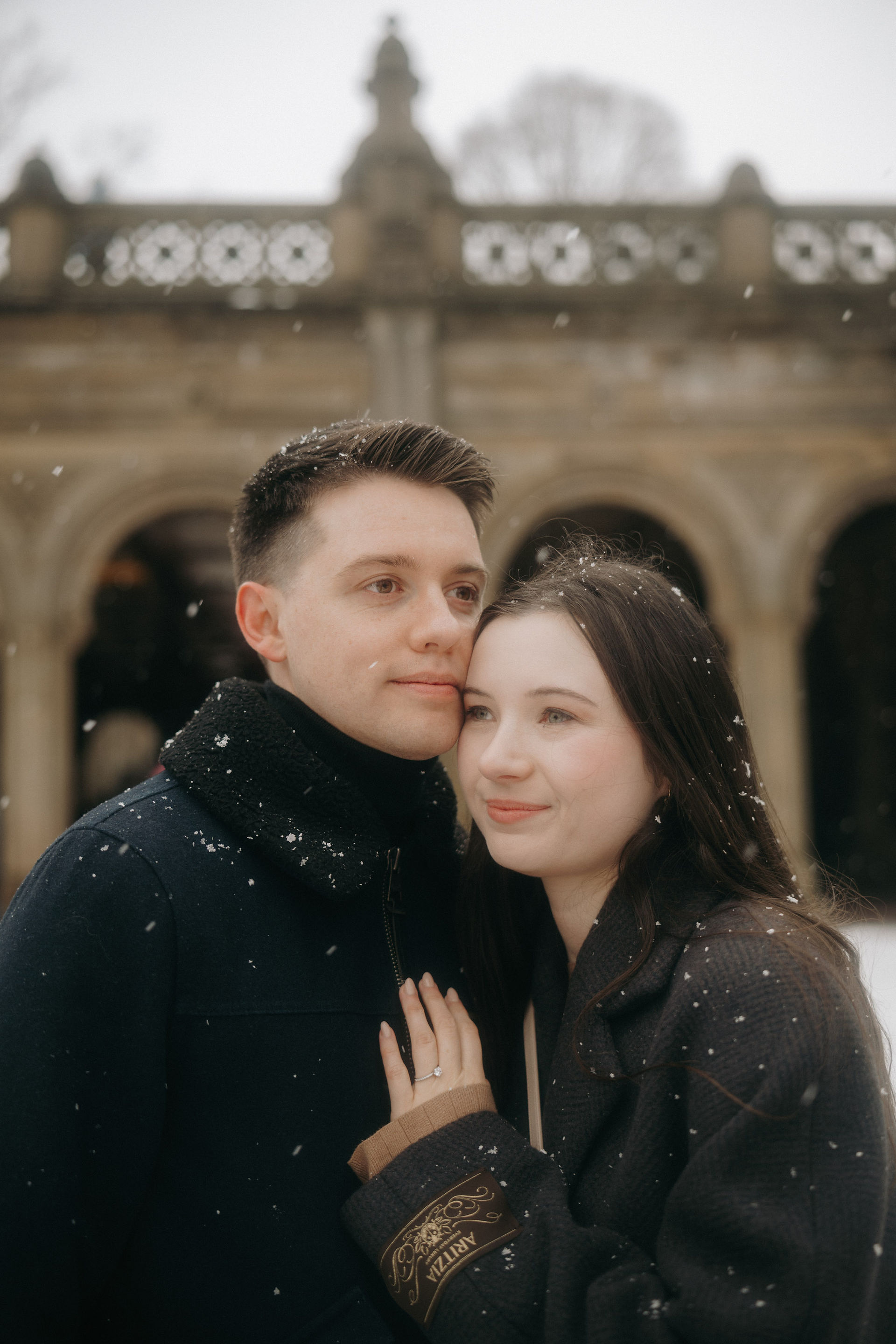
Winter (December–March): Bare trees reveal the skyline through the branches in a way the other seasons don't allow. Snow transforms every location. The park is at its least crowded and, in the right conditions, its most dramatic. A winter Central Park photoshoot with fresh snow is one of the most underrated sessions.






Frequently Asked Questions
Do you need a permit for a Central Park photoshoot? For most couples and small groups, no permit is required. Ceremonies and commercial shoots with 20 or more people require a permit through the Central Park Conservancy. When in doubt, check directly at centralparknyc.org.
What is the best time of day for photos in Central Park? The hour after sunrise and the 90 minutes before sunset — what photographers call golden hour — give the most flattering, atmospheric light. Early morning on weekdays also gives you the best chance of having popular locations to yourselves.
What is Bethesda Terrace known for? Bethesda Terrace is the iconic two-tiered esplanade at the center of Central Park, anchored by the Angel of the Waters fountain. It's known for its ornate stonework, the Minton tile arcade underneath, and its views across the Lake toward Bow Bridge. It's one of the most photographed locations in New York City, and an incredibly romantic spot for a couple's Central Park photoshoot in the early morning.
Where is the Ladies Pavilion in Central Park? The Ladies Pavilion is a Victorian cast-iron gazebo on the western shore of the Lake, near the 72nd Street entrance on the west side of the park. It overlooks the water toward Bow Bridge and is a popular location for intimate ceremonies and couple portraits.
What is the least crowded part of Central Park for photos? The North Woods — including the Loch, the Ravine, and the Waterfall — are the least visited and most naturally wild areas of the park. The Conservatory Garden on the east side near 105th Street is also significantly less crowded than the south end of the park.
How long does a Central Park photoshoot take? Most couple and engagement sessions run 1–2 hours, which is enough time to cover several locations within the park. A creative or extended session of 2+ hours gives you the flexibility to work across different areas, from the south end near Bethesda Terrace to quieter spots further north.
All The Feels by Mucci photographs couples, elopements, and engagements throughout Central Park. Get in touch if you're planning a session.


Comments